Showing posts with label Classics. Show all posts

Monday, May 2, 2011

Baroness Emmuska Orczy - "The Scarlet Pimpernel"

     If you're in the market for a good historical fiction, filled with lords and ladies, crafty disguises, sneaky spies, dire situations, and ingenious escapes, then I recommend you check out this much beloved classic!  This tale has been retold in various movies, and stage productions, but in my humble opinion, the book is always better ;) 

     Our tale opens in 1792, "the year of grace" with a captain in the army of the republic bragging about how none of the sneaky members of the League of the Scarlet Pimpernel have gotten any royal refugees past his barricade because of his keen eyes!  Shortly after, a loathsome, haggard old woman takes her vegetable cart through that very same barricade to visit her grandson with smallpox.  Lo and behold, that very same "woman" was in actuality the man, the myth, the legendary Scarlet Pimpernel himself! 

     According to Baroness Orczy, during the French Revolution, there was a band of English spies who risked life and limb to smuggle those who were headed to Mme. Guillotine out of the country to their neighboring refuge, England.  This group consisted of about 20 young, gallant, and even wealthy English gentlemen who were lead by one resourceful and daring genius who called himself The Scarlet Pimpernel (named after a small red English flower).   
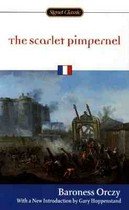
The Scarlet Pimpernel
     Some of the main characters are Sir Percy Blankney, Marguerite (his wife), Armand St. Just (her brother), Chauvelin (a malicious French spy), Andrew Ffoulkes, and a hoard of other minor characters.   Marguerite is a young French woman who is hailed as the wittiest woman in Europe, and everyone is surprised when she marries Sir Percy as he is said to be somewhat dimwitted and foppish (a lovely English term used to describe vain man who is mostly concerned about their appearance and dress).  With Sir Percy's vast fortune and lovely wife, he is touted as one of the luckiest men around, as well as one of the most popular and fashionable as he is always impeccably dressed for every occasion.  Marguerite and Percy have been married about a year at this point in the story and their love has grown cold, she feels trapped in a marriage that began wonderfully, but due to an earlier indiscretion on her part, they grew apart.  She tries throughout the story to re-ignite that love.

     One of the biggest plot lines that comprises this story is that of the rescue of The Comte de Tournay.  At the beginning of the story, Sir Andrew delivers The Comtesse de Tournay and her two children to the Fisherman's Rest, a little inn near the coast of Dover, England.  As this plot is unfolding, Chauvelin makes his way to England in an attempt to solicit information regarding The Scarlet Pimpernel so that the next time our hero sets foot upon French soil, he can be arrested and escorted to the Guillotine.  As fate would have it, Chauvelin discovers information about Armand St. Just and uses it as leverage against Marguerite.  He offers her a deal: She finds out what she can about The Scarlet Pimpernel and his identity, and Chauvelin will personally see to it that Armand gets out of France safely.

     What happens????? You'll just have to read it to find out!  This is certainly an action packed story that boasts some pretty tense moments throughout.  There is a fair amount of mystery and suspense within these pages as well.  I do have to say, that it took a chapter or two to really grab my attention, but from that point on, it was a page-turner, through and through!!!!

Thursday, April 7, 2011

Louisa May Alcott - "Little Women"

     Long time, no blog, I know, but here is the latest edition, and it's hot off the press too!  I've just finished Louisa May Alcott's famous classic, "Little Women."  I read it when I was a kid, and have enjoyed the movie over and over so I figured it was time to revisit this much beloved book.  I don't even know if I can do this book justice here in my humble blog.  It's so good, and I'm afraid there's nothing I can say here that will express the greatness that is this story.  Seriously?!?!?! What does one write about "LITTLE WOMEN"??? I'll give it a go regardless...

     This lovely little gem tells the story of four sisters: Meg, Jo, Beth, and Amy March.  It is both written, and set in the 1860's during the Civil War.  The story starts in the winter while their father, Mr. March, is away doing his duty with the Union army as a chaplain, and the five March women (the four girls and their beloved mother, "Marmee") are home waiting for his return.  The family is suffering financial poverty, and the book tells of how they all learn to make do with what they do have.  The story begins when the girls are young, Meg is about 16, Jo 15, Beth 13, and Amy is 10 or so, and it follows their lives throughout their, "coming of age." 

    Each of the girls has their own passions that are explored throughout the length of the novel.  Meg is a very prim and proper young lady who longs to have a carefree life, and to be able to "live in the lap of luxury" as some of her wealthier friends do instead of have to work as a governess.  She's very conscious of others' view of her.  Jo is a tomboy who fancies herself a playwright, actress, "man of the house," adventurer, poet, and author.  Beth is quiet and caring; she's a homebody, the mother to a family of dolls, the care-taker of cats and their kittens, and a gentle domestic servant of the household.  Beth is the musician in the family; she loves to play her piano, and continually longs for new music to learn and play for the family.  Amy is a precocious little blond girl who wants to marry a wealthy man and be a gracious and elegant gentlewoman in the upper echelons of society as well as a great artist.

Little Women (Oxford World's Classics)
    The story tells of both the public and private lives of all of the characters, and I found myself getting attached to them all.  Each girl's story is about their own struggles they face as they experience the rites of passage one encounters on their journey to womanhood.  It's an interesting peep into what life was like for girls in that era.  So much has changed since then, some things for the better, and others...not so much. 

     There is a very strong "message of morality" woven throughout the book, and for the most part it is truly, "woven into" the story as opposed to being preached outright.  The girls all make decisions throughout their coming-if-age and are all experience the consequences.  These little women are encouraged to live rightly and to become good women. 

     As I said before, there's no way I can do justice to such an enduring classic, and I haven't really, so I strongly recommend this book to anyone who is interested in the past, and what it was like to live as a woman then.  As cliche as it may sound, reading this made me want to be a better person.  It contains a truly heartwarming tale, and I'm so glad I re-read it to refresh my memory.

     Enjoy the classics; they're "classic" for a reason ;)
    

Sunday, June 20, 2010

Charles Dickens - "A Tale of Two Cities"

     One memorial service, one and one - half months, three mini vacations, and one VERY LONG Brit. lit classic later, "The B!+@h is Back" - Sir Elton John  (I thought I'd stick with the British theme one second longer).

     The way this came about is mainly because I needed to soothe my conscience.  "How?" You ask.  Toward the end of my senior year of high school I was supposed to write a book report on this timeless classic.  I had a perfect GPA (no, seriously), a bad case of "Senioritis," and no desire to ACTUALLY read this book.  I know, it surprises me too.  I did, however, write a report worthy of a B+ based on the CliffsNotes version of it.  Sorry Mrs. Brown!  A full decade passed before I decided that it was time to make amends.

     It actually took FOREVER to read this book, partially because my brain hasn't had to digest Victorian English and it's extensive vocabulary for just under the ten year mark, and also because I've had an extremely full plate over the past month and a half.  I discovered that it's difficult to read classics when there is anything else going on in your life (music, work, cats, car sickness, etc) which is probably why I've never read it until now.

     That's right, I still have my mom's copy from 1962.  An interesting side note: Whoever worked for Scholastic Publishers the year that this edition went to print should lay off the drugs.  The reason being that one of the MAIN characters, Sydney Carton, has his name spelled as such.  If you read the summary on the back of this edition it's written Sidney Carton.  Hmm...  Now, enough about my personal life, and on with the show.

     When I first began the story it was like pulling teeth to read.  I didn't understand a lot of the language (or much of the history of the French Revolution, for that matter).  Lately I've mostly only consumed books that don't take much brain power to digest.  I have to admit, once I got through the first 364 (of 468) pages, I began to see where it was going, and to actually WANTED to finish it.  Sad, right?  Anyway, as I began to get a picture of what it was like to be there in Late 1700's France and England, according to Chuck, it started to make a little more sense.  I do own up to visiting http://www.sparknotes.com/lit/twocities/for some extra comprehension, and I actually made a 96% on their quiz too!

     I must admit, that despite all the difficulties, I really enjoyed the way Dickens weaves together this twisted and somewhat dark tale of kharma, altruism, and a love triangle set with the bloody French Revolution as it's backdrop.  I'm not saying that I am ready to jump into another classic right away, or that I like a book to take +/-  1-1/2 months to complete, but I am saying that I feel like I've made amends with my conscience and have the bragging rights to say that I've now read one of literature's greatest.

     The characters in this book were written in such a way as to represent a people group ("Jaques" the mender of roads), or to act as a full personification of a character trait (Lucie displaying ultimate gentility and compassion; Madame Defarge is a prime example of one who will stop at nothing to extract revenge whether it be deserved or otherwise).  Dickens even uses their names to help convey the depth or extent of their portrayal of a trait (Mr. Stryver strives for a better position in life).

     The plot is very well written to where the different plot lines and plot points are so delicately weaved into the story that when the end comes, it catches you off guard.  At least it did in my case.  I do have to say that I'm glad I finally read it, and enjoyed it (at least the end).  It was really hard to get through a lot of it because I had trouble seeing where it was leading me, however; in the end it was worth it.

     I hope you enjoyed my brief and fairly inarticulate opinion of one of literature's greats.  Please come back for my next episode right here at the same bat time on the same bat channel.

Until then, my friends Adieu...